
Before ETFs, Buying The Market Was A Big Job
Imagine wanting to invest in a whole market rather than betting on one company. Before exchange-traded funds, that could mean buying many separate stocks, deciding how much of each to own, and keeping the mix balanced over time. A mutual fund could collect many investments in one place, but it was normally bought or sold through the fund at a price calculated after the market closed. That worked, but it did not trade like an ordinary stock.

An ETF changed the package. It is a fund that holds a basket of assets, but its shares trade on an exchange during the market day. In other words, it is part investment fund and part stock ticker. One ETF may hold hundreds of stocks, a collection of bonds, a group of international companies, or something much narrower. Buying one share does not mean you directly own every company in the basket. It means you own a small slice of the fund that owns them.
Canada Built The Prototype—Then America Made It Huge
The ETF story starts in Canada, not on Wall Street. In 1990, the Toronto Stock Exchange listed the Toronto 35 Index Participation Units, known as TIPs. TMX calls it the world’s first exchange-traded, index-linked product and the prototype for the modern ETF. It let investors trade an interest in a group of major Canadian companies on an exchange instead of assembling that group themselves. The original product later evolved into the iShares S&P/TSX 60 Index ETF, which trades in Canada today.

The next major step was SPY, the SPDR S&P 500 ETF Trust. It began trading in the United States on January 22, 1993, as the first U.S.-listed ETF. State Street says the idea was shaped by the search for a broad-market trading vehicle after the 1987 Black Monday crash. SPY gave people one exchange-traded way to follow a large slice of the U.S. stock market. That is why it became such an important proof of concept: a complicated collection of companies could be bought or sold through one simple security.
The Clever Plumbing That Makes An ETF Work
The basic idea is easy. The machinery behind it is clever. An ETF manager decides what the fund will hold—for example, stocks that follow an index or bonds chosen under a stated strategy. You buy and sell ETF shares through a brokerage account, just as you would buy and sell a public company’s shares. The share price moves during the day because buyers and sellers are meeting in the market.
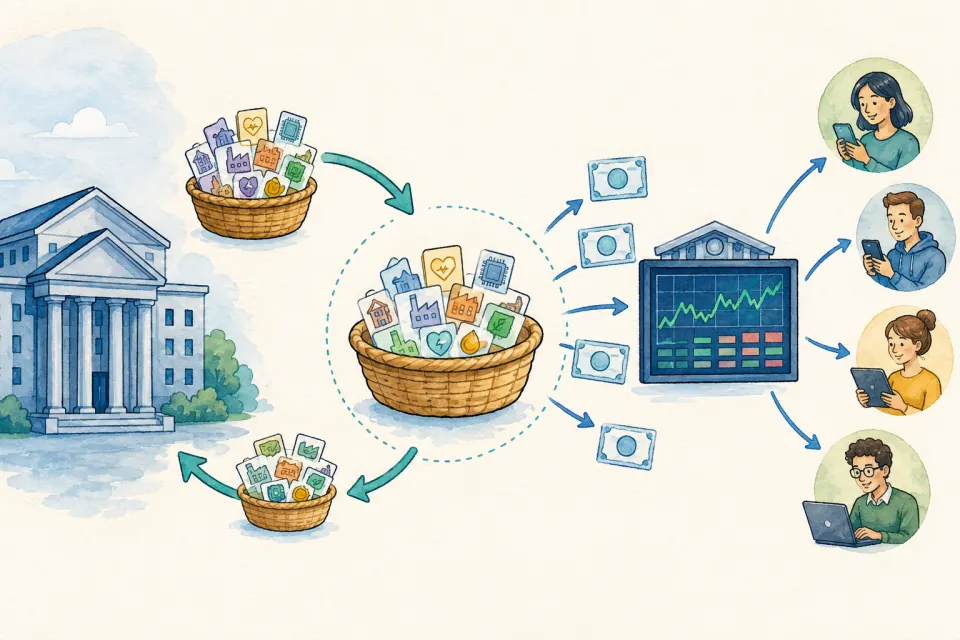
There is also a wholesale layer most people never see. Large financial firms called authorized participants can hand the fund a basket of assets or cash and receive a large block of ETF shares. They can do the reverse as well. This creation-and-redemption process can increase or reduce the supply of ETF shares when demand changes. It gives professionals a reason to step in when an ETF’s market price drifts away from the value of what it holds. That is one reason an ETF’s price often stays close to its net asset value, although it can trade at a premium or discount and is not guaranteed to match perfectly.
Why Electronic Trading Turned ETFs Into A Retail Tool
ETFs did not invent electronic trading or online brokerages. They fit that world extremely well. Because an ETF has a ticker and trades on an exchange, an investor can generally see a live market price during trading hours and use the same kind of order choices used for stocks. A mutual fund transaction normally happens at the next calculated net asset value after the market closes. An ETF can be bought or sold during the day, which made the format feel familiar as discount brokerages, websites, and eventually mobile investing apps reached more people.
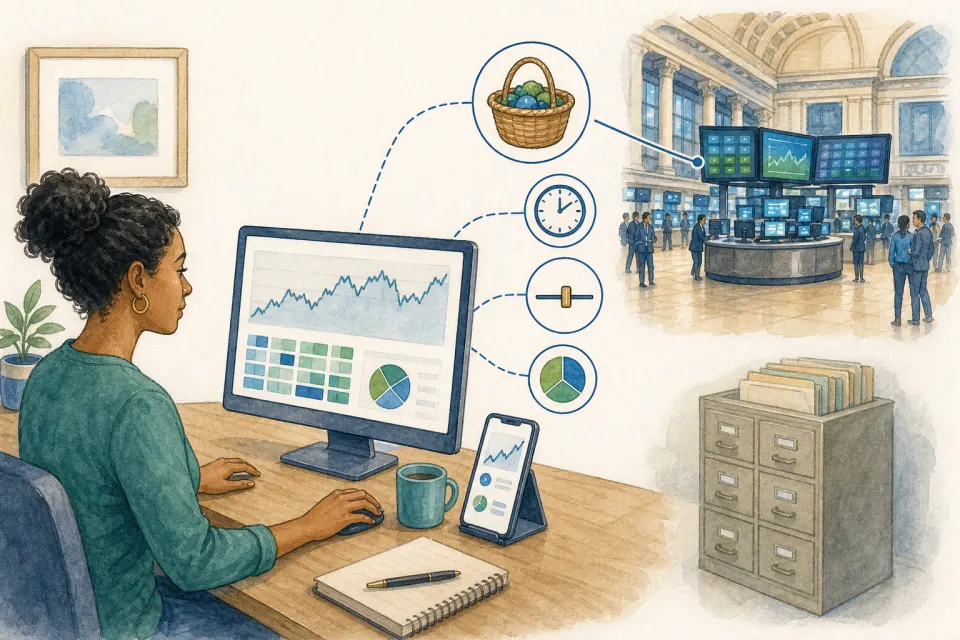
The size of the purchase was revolutionary. Instead of needing enough money to buy every stock in a broad index, an investor could start with the cost of one ETF share. Some brokerages also offer fractional ETF shares, though that is a brokerage feature, not something every investor must have. The important point is not that every ETF is cheap—some share prices are high. It is that one trade can provide exposure to a large group of investments that would be far harder to buy one by one.
From One U.S. Ticker To A $13 Trillion Market—And Canada Still Punches Up
The scale now is hard to picture. The Investment Company Institute reported that, at the end of 2025, the United States had 4,495 index-based and actively managed ETFs, including commodity ETFs, with $13.4 trillion in assets. That was about 30% of the assets managed by U.S. investment companies. ICI estimated that 19.8 million U.S. households held ETFs in 2025. A product that began as one way to trade a broad stock index has become a huge part of how Americans hold stocks, bonds, commodities, and specialized strategies.

Canada remains a meaningful part of the story. The Canadian ETF Association reported 2,008 Canadian-listed ETFs, $912 billion in net assets, and 51 providers across two Canadian exchanges as of its September 2026 market summary. Canadian investors can choose funds focused on Canada, the United States, the world, bonds, cash-like holdings, and ready-made portfolios that mix several asset types. A Canadian-listed ETF can make access convenient, but investors still need to look at what it owns, its management fee, its currency exposure, and its tax treatment in the account they use.
The ETF Future Is More Choice—Not A Crystal Ball
The next phase is likely to be less about one breakthrough product and more about more kinds of wrappers. ETFs already hold broad index portfolios, individual market sectors, bonds, cash-like investments, and all-in-one asset-allocation mixes. More actively managed ETFs are arriving too, where a manager chooses investments instead of following a published index. Newer categories include crypto-asset products, covered-call products, and highly specialized single-stock or leveraged funds. The SEC’s ETF Rule, adopted in 2019, was designed to lower the cost and delay of launching qualifying ETFs while adding standardized transparency and trading disclosures.

That growth is already visible. ICI says 757 ETFs launched in the United States in 2024, a record at the time. CETFA says Canadian ETF launches reached 374 in 2025, also a record. The reasonable expectation is more choice, more competition, and more products built around narrow ideas. The part no one can know is which products will help long-term investors and which will mostly create trading noise. More choice is not automatically better; it can just make a simple decision harder.
The ETF Trap: A Convenient Package Is Not A Safe Investment
An ETF is a container, not a promise. A broad stock-market ETF can fall when stock markets fall. A bond ETF can lose value when rates rise. A narrow sector ETF can be far less diversified than its name suggests. Leveraged and inverse ETFs are designed for short-term objectives and can behave very differently from a regular index ETF. The fund’s label tells you very little by itself; the holdings and strategy do the real work.

There are costs beyond the management fee. ETF buyers may face brokerage commissions, bid-ask spreads, and a market price that sits above or below the value of the fund’s holdings. Before buying any ETF, ask a few plain questions: What does it own? Is it index-based or actively managed? How much does it charge? Is it broad or narrowly focused? Could I handle a large drop without selling in panic? ETFs made investing more accessible. They did not remove the need for a plan, patience, diversification, or personal judgment. This article is education, not personal investment advice.
Sources
- Toronto Stock Exchange Celebrates 30 Years of ETFs TMX Group
- SPY: The Original S&P 500 ETF State Street Investment Management
- ETF Basics and Structure: FAQs Investment Company Institute
- The US ETF Market: FAQs Investment Company Institute
- Canadian ETF Association Market Statistics Canadian ETF Association
- Canada's 2025 ETF Recap – The Year of Asset Allocation ETFs Canadian ETF Association
- SEC Adopts New Rule to Modernize Regulation of Exchange-Traded Funds U.S. Securities and Exchange Commission
- Mutual Fund and ETF Fees and Expenses – Investor Bulletin Investor.gov
- ETF history
- ETFs explained
- exchange traded funds
- first ETF Canada
- SPY ETF history
- US ETF market
- Canadian ETFs
- retail investing
- ETF investing
- ETF trading
- ETF future
- ETF risks