
First: Bonds Are Not ‘High.’ Their Yields Are.
A Treasury bond is basically an IOU from the U.S. government. Investors lend the government money, and the government promises interest payments and repayment later. The yield is the return a new buyer can expect from that bond. It is the interest-rate number people quote on the news.
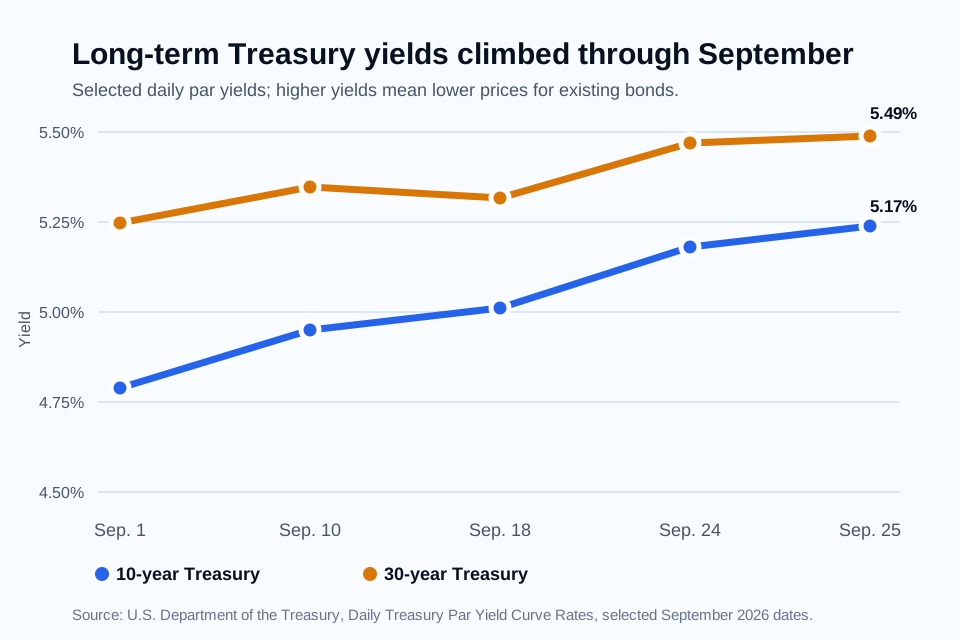
Here is the confusing part: bond prices and bond yields usually move in opposite directions. When investors demand a higher yield, the market price of existing bonds falls. So the recent headline is not that Treasury bond prices are at all-time highs. It is that long-term Treasury yields have climbed to levels not seen in roughly two decades. That makes the cost of money across the economy much louder.
Why do people care about one government-bond number? Because U.S. Treasuries are treated as a basic benchmark. A lender deciding what to charge for a mortgage, a company selling new bonds, or an investor choosing between stocks and safer income all start by looking at what the government itself has to pay.
What Just Changed in the Bond Market?
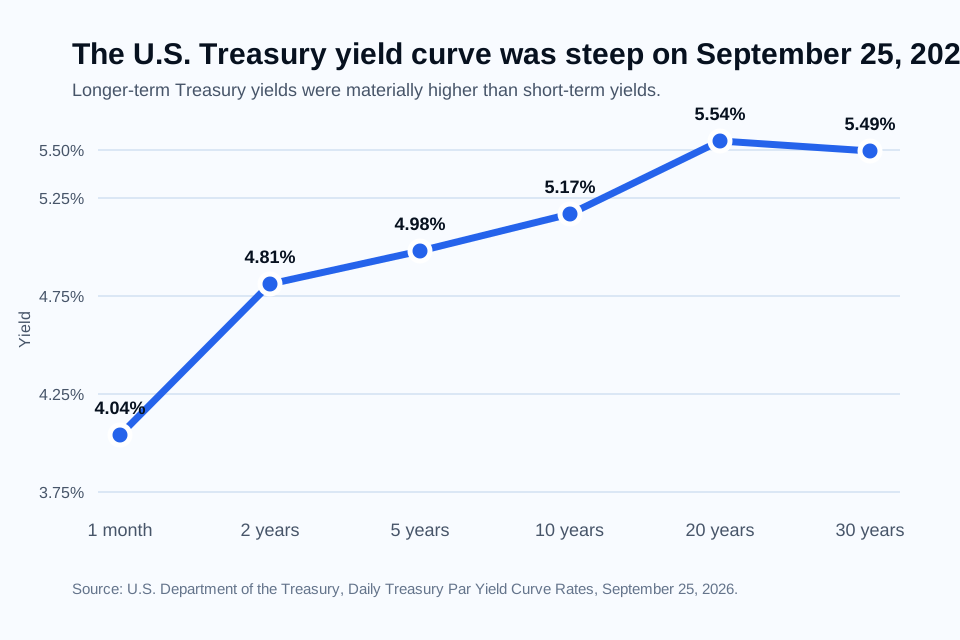
The rise has been fast. Treasury’s official daily data show the 10-year yield moved from 4.79% on September 1 to 5.17% on September 25. Over the same dates, the 30-year yield moved from 5.27% to 5.49%. Reuters reported that the 30-year yield reached its highest level since 2004 during the move, while the 10-year yield pushed above 5%.
There is no single switch that explains it. Investors have been weighing inflation risk, higher energy costs, stronger-than-expected economic activity, big government borrowing needs, and the possibility that the Federal Reserve may need to keep policy tighter for longer. Bond markets are trying to price all of those possibilities at once.
Your Mortgage Does Not Say ‘Treasury’—But It Feels Treasury Yields
A 30-year mortgage is not literally priced at the 10-year Treasury yield. Mortgage investors face different risks, including the chance that homeowners refinance early, and lenders add costs and a margin. Still, the 10-year Treasury is a major reference point. Research from the Dallas Fed says mortgage rates can generally be thought of as the 10-year Treasury rate plus a spread that changes with rate volatility, the yield curve, and mortgage-market conditions.

That link is showing up in real borrowing costs. Freddie Mac’s September 24 release put the average 30-year fixed mortgage rate at 7.03%. A higher rate can reduce how much house a buyer can afford for the same monthly payment. It can also slow home sales, construction, furniture purchases, and renovations. People with an existing fixed mortgage are mostly insulated until they refinance, move, or borrow again.
If you are comparing a home purchase at different rates, the Mortgage Calculator can turn the abstract percentage into a monthly-payment estimate. The useful question is not only ‘Will rates fall?’ but also ‘Can this payment work if they do not?’
Corporate Earnings Get Squeezed When Cheap Debt Expires
Companies do not all borrow at the same rate. They normally pay a Treasury yield plus an extra amount, called a credit spread, to compensate lenders for the risk of lending to that company. When the Treasury part rises, the starting point rises for almost everyone.
The pain is greatest for a company that needs to borrow now, refinance an old bond, or carries floating-rate debt. Its interest bill can rise before sales rise. That can squeeze profit, delay a new factory, make a data centre less attractive, or leave less money for hiring and share buybacks. A company that locked in cheap fixed-rate debt years ago has more time before the higher-rate world reaches its income statement.
Higher yields also compete with stocks. If a relatively safe Treasury offers a bigger return, investors may be less willing to pay a very high price for a company whose profits are expected far in the future. That is why expensive, fast-growing shares can be sensitive to a bond-market jump. But it is not automatic: if yields rise because the economy and company profits are strong, stocks can still do well.
The Grocery Store Connection Is Real—but Indirect
A 30-year Treasury yield does not raise the price of a carton of eggs the next morning. Groceries are shaped most directly by food and energy costs, weather, labour, transport, trade policy, competition, and supply disruptions. Anyone claiming that bonds alone explain your grocery bill is skipping most of the story.

The link is through financing. Stores, wholesalers, farms, food processors, trucking businesses, and suppliers often use credit to buy inventory, build warehouses, replace equipment, or bridge the time between paying a supplier and getting paid by a customer. Higher market rates can make that credit more expensive. Some firms absorb it in lower profit; some may try to pass part of it on.
That is why bonds matter even when they feel far away from the checkout line. They are part of the financial conditions that influence how freely households and companies can spend, borrow, invest, and expand. The Federal Reserve stresses that these links are important but neither direct nor immediate.
Who Feels Higher Yields First?
New borrowers feel it first: homebuyers, businesses issuing new bonds, governments renewing debt, and people financing a vehicle. Borrowers with variable-rate debt can feel it sooner than people locked into a fixed rate. Savers may get some upside because new savings products and newly issued bonds can offer better yields, though the return depends on the product, term, taxes, and inflation.
The effects also arrive on different schedules. A company may have years before an old low-rate bond matures. A shopper may never see an itemized ‘bond yield’ charge. A family with a fixed mortgage may notice nothing until they sell. But, across the economy, more expensive money tends to cool borrowing and investment. That is why bond yields can matter to jobs, pay raises, house prices, and company results long before they become dinner-table conversation.
What to Watch Without Panicking
Watch the 10-year and 30-year Treasury yields as signals, not predictions. A one-day move does not rewrite your finances. The more meaningful question is whether high long-term yields stay high for months, because that is when lenders, businesses, and households have to make new decisions at the higher cost of money.
For your own finances, focus on the rate that actually applies to you: the mortgage you are being offered, the balance on a variable-rate loan, the date a fixed loan resets, or the yield on the savings product you are considering. Boring bonds are not boring when they change those numbers. They are one of the quiet prices underneath many of the loud prices you see every day.
Sources
- Daily Treasury Par Yield Curve Rates U.S. Department of the Treasury
- Treasury yields are rising — why does it matter? Reuters, via Investing.com
- Why Mortgage Rates Exceed Treasury Yields Federal Reserve Bank of Boston
- What drives mortgage rates and their response to monetary policy changes Federal Reserve Bank of Dallas
- Media Room: Mortgage Rates Average 7.03% Freddie Mac
- How does the Federal Reserve affect inflation and employment? Federal Reserve Board
- Treasury yields
- U.S. bonds
- mortgage rates
- corporate borrowing costs
- grocery prices
- interest rates
- bond market explained